
Off-Grid Earthships: Homes from Recycled Materials
Individuals often dream of residing closer to nature, independent of utility bills and excessive consumption. Envision a dwelling that maintains comfortable temperatures year-round while operating entirely off-grid. Earthships realize this ideal by utilizing recycled materials like tires, glass bottles, and aluminum cans to construct sustainable structures that embody ingenuity and environmental stewardship.
The Allure of Off-Grid Existence
Picture rising to sunlight passing through translucent bottle walls, accompanied by the whisper of wind rather than urban noise. This lifestyle attracts those who value autonomy, innovation, and ecological accountability. Earthships function as integrated systems that harness local resources for rainwater collection, electricity generation, and food production. For those desiring a reduced environmental impact and stronger bond with the earth, these homes deliver aesthetic appeal alongside functional efficiency.
Defining an Earthship
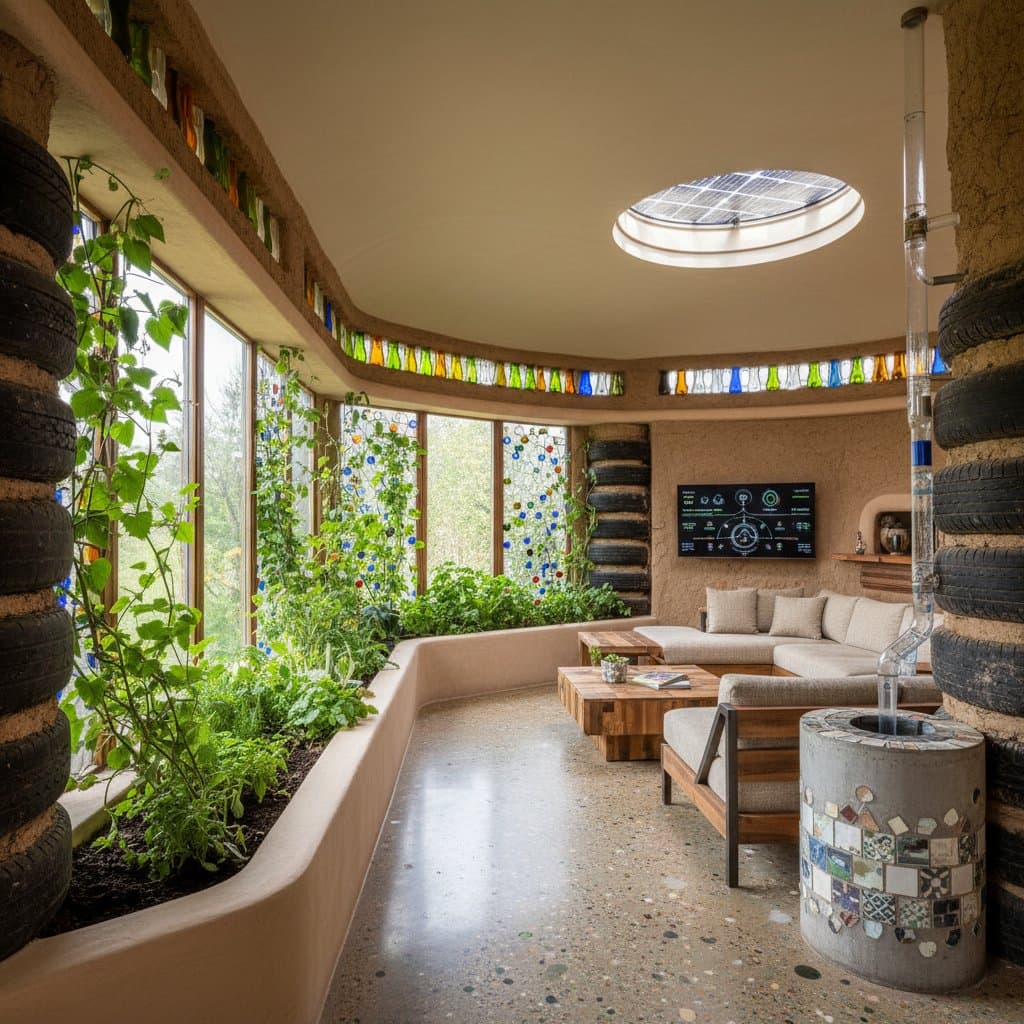
An Earthship represents a passive solar dwelling that merges natural and repurposed materials with contemporary engineering. Primary walls consist of tires packed with rammed earth, arranged in a brick-like pattern to provide thermal mass and structural integrity. Translucent partitions incorporate glass bottles and aluminum cans set in mortar, permitting natural light diffusion while enhancing insulation. The overarching objective involves engineering a residence that operates autonomously, managing energy, water, and waste with limited external reliance.
Earthships incorporate six essential systems: passive solar and thermal heating, solar and wind power generation, rainwater harvesting, on-site sewage processing, integrated food cultivation, and construction from natural or recycled elements. These components interconnect to form a closed-loop ecosystem, fostering comfortable habitation with minimal resource demands.
Construction Using Recycled and Repurposed Materials
The building process begins with materials typically destined for disposal. Automobile tires serve as foundational elements, filled with compacted earth to yield robust, load-bearing walls capable of withstanding seismic activity. Glass bottles and cans, mortared into place, create luminous dividers that filter sunlight into interiors. Reclaimed lumber, salvaged window frames, and repurposed metal contribute to structural supports and interior detailing. The finished structure exudes an organic character, with each element narrating a tale of reclamation.
This approach extends beyond landfill diversion. It diminishes reliance on resource-heavy production and logistics. Constructing an Earthship directly mitigates waste accumulation and preserves natural reserves, aligning personal shelter with broader planetary health.
Practical Considerations for Off-Grid Implementation
Transitioning to off-grid living demands thorough preparation and dedication. Evaluate regional regulations, including building codes and land-use restrictions, prior to commencement. Certain jurisdictions accommodate unconventional builds, whereas others necessitate specialized permits or structural certifications. Engage a contractor versed in eco-friendly architecture to streamline compliance and execution.
Financial planning forms a critical component. A modest Earthship may cost significantly less than a standard residence, particularly when owners contribute manual labor. Expansive or feature-rich variants incur greater expense, especially with sophisticated solar arrays or purification technologies. Owners frequently phase construction, prioritizing core living areas before expanding to greenhouses or supplemental energy sources.
Achieving Comfort Through Integrated Natural Systems
Earthships leverage environmental dynamics for internal equilibrium. Substantial earth-filled walls store daytime heat and radiate it nocturnally, stabilizing temperatures without mechanical intervention. South-oriented glazing maximizes solar gain for passive warming, complemented by strategic vents for airflow circulation. Roof-collected rainwater undergoes filtration for potable use, irrigation, and sanitation.
Electricity derives from photovoltaic panels coupled with battery storage, augmented by wind generators in suitable locales. Food systems utilize treated greywater to irrigate enclosed planters bearing citrus trees, vegetable crops, and herbs. This cyclical methodology optimizes resource use, yielding a residence that collaborates symbiotically with its surroundings.
Steps to Construct Your Earthship
To pursue an Earthship project, investigate nearby installations for firsthand insight. Numerous regions host off-grid enclaves; touring an operational model reveals system interdependencies. Draft preliminary designs, establish a feasible budget, and consult experts in alternative building techniques. Address permitting requirements, conduct geotechnical assessments, and outline energy strategies to refine the blueprint.
Upon readiness, share your initiative on doricsouth.com at no charge. Access verified specialists in sustainable and off-grid projects. These professionals assist in design optimization, material procurement, and oversight to ensure a secure, effective build.
Embracing Daily Life in an Earthship
Completion brings ongoing benefits rooted in tangible experiences. Observe natural thermal fluctuations guided by solar cycles, savor harvests from adjacent growing spaces, and recognize the purposeful integration of every feature. This existence cultivates profound appreciation for natural patterns and the craft of resilient design.