
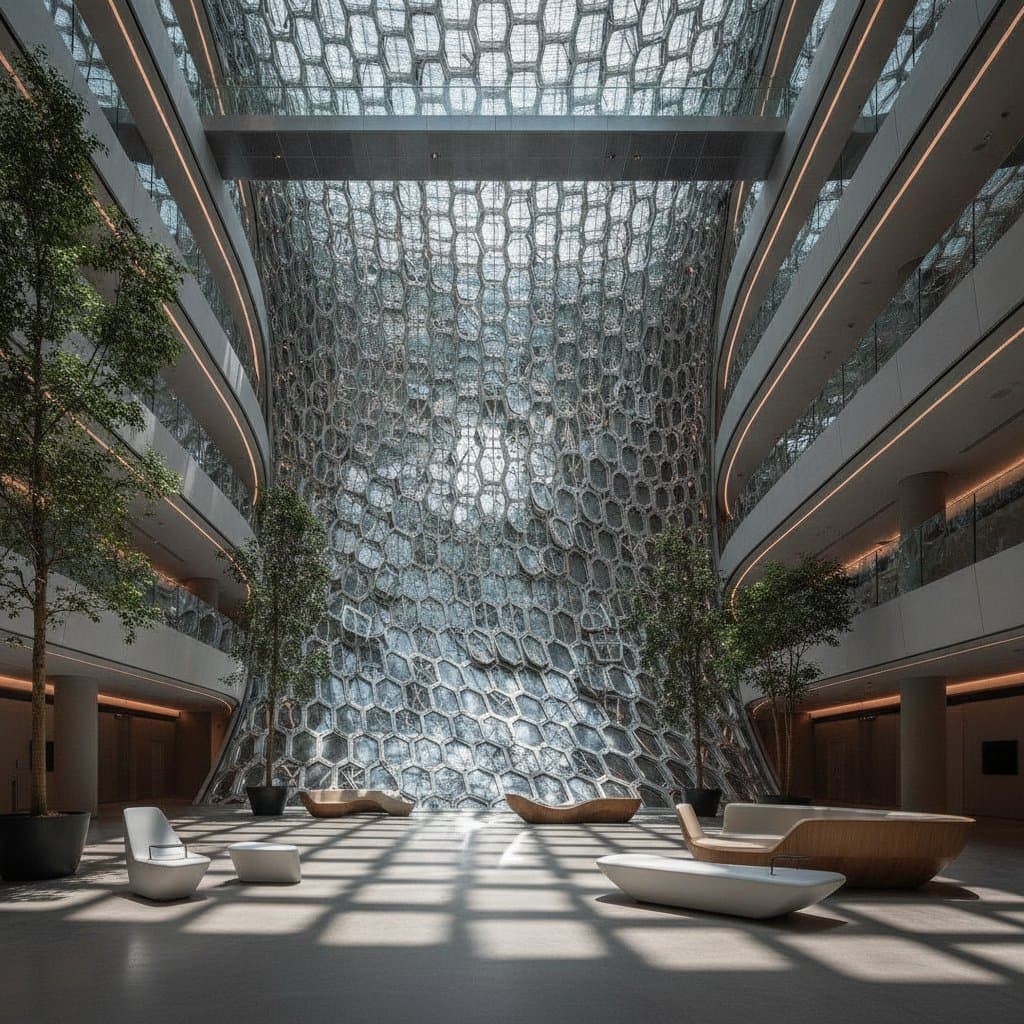
Parametric Facades Using Math to Revolutionize Design
Imagine walking past a building whose surface shifts gently with the changing light. Panels adjust their angles throughout the day. From each viewpoint the pattern appears deliberate yet fluid. This effect arises from parametric facades that combine mathematics with architectural intent.
Limitations of Conventional Building Envelopes
Conventional facades remain fixed once installed. They provide weather protection and visual identity yet offer little response to daily or seasonal shifts. Many urban districts therefore display repetitive surfaces that ignore local sun paths or wind patterns. Designers began to explore whether a facade could adjust its form to improve comfort and reduce energy demand.
Defining a Parametric Facade
A parametric facade is generated through algorithms that accept measurable inputs. Parameters such as solar altitude, wind pressure, or occupant density drive the geometry. When any input changes, the model updates panel depth, perforation size, or spacing automatically. The designer retains control by setting the rules while the computation produces multiple viable outcomes.
Each resulting surface balances performance criteria with visual order. A single set of equations can govern shading angles across an entire elevation. The outcome is a coherent pattern that still varies in response to its immediate context.
Mathematical Relationships That Shape Performance
Algorithmic models link variables so that adjustments in one area propagate through the design. Four common relationships illustrate the method.
- Solar geometry determines panel tilt to reduce midday heat gain while preserving morning and afternoon daylight.
- Wind load calculations set the required thickness or curvature of each element.
- Ventilation needs dictate opening sizes that maintain airflow without excessive heat loss.
- Structural optimization routines minimize material volume while meeting strength requirements.
These relationships produce patterns that serve measurable goals rather than arbitrary decoration.
Real-World Applications Across Climates
Cultural buildings and commercial towers already employ these systems. Some installations use hinged metal petals that open as temperatures rise. Others rely on fixed yet parametrically spaced screens that cast shifting geometric shadows indoors. In warm, humid regions the same logic increases airflow to lower cooling loads. In cooler zones it maximizes useful solar gain during winter months.
Because each project begins with site-specific data, the resulting facade reflects local conditions instead of a generic template.
Practical Considerations During Implementation
Parametric work requires early collaboration among architects, engineers, and fabricators. Panel dimensions must be coordinated with manufacturing tolerances. Budgets depend on repetition versus uniqueness. Simple modular systems remain economical, while fully kinetic assemblies increase both fabrication and upkeep costs.
Material choices affect appearance and thermal behavior. Perforated aluminum offers lightness and recyclability. Glass options provide transparency with variable frit patterns. Maintenance access must be planned for any moving components. Local code officials may request additional engineering documentation for nonstandard assemblies.
Long-term operating savings frequently offset these initial demands.
Shift Toward Performance-Based Design
Architects adopt parametric methods because they prioritize measurable behavior over static appearance. Virtual testing allows rapid comparison of options before construction begins. The process therefore becomes iterative, guided by data yet open to creative refinement.
Steps to Introduce Parametric Methods
Begin by assembling a team experienced in algorithmic modeling. Define the primary performance targets for the project site. Translate those targets into parameters that the software can vary. Review generated options against cost, code, and aesthetic criteria. Proceed to detailed documentation once a preferred solution is selected.
Parametric facades demonstrate that precise calculation and responsive architecture can coexist. The resulting surfaces improve comfort, reduce resource use, and give each building a distinct identity shaped by its own environment.