
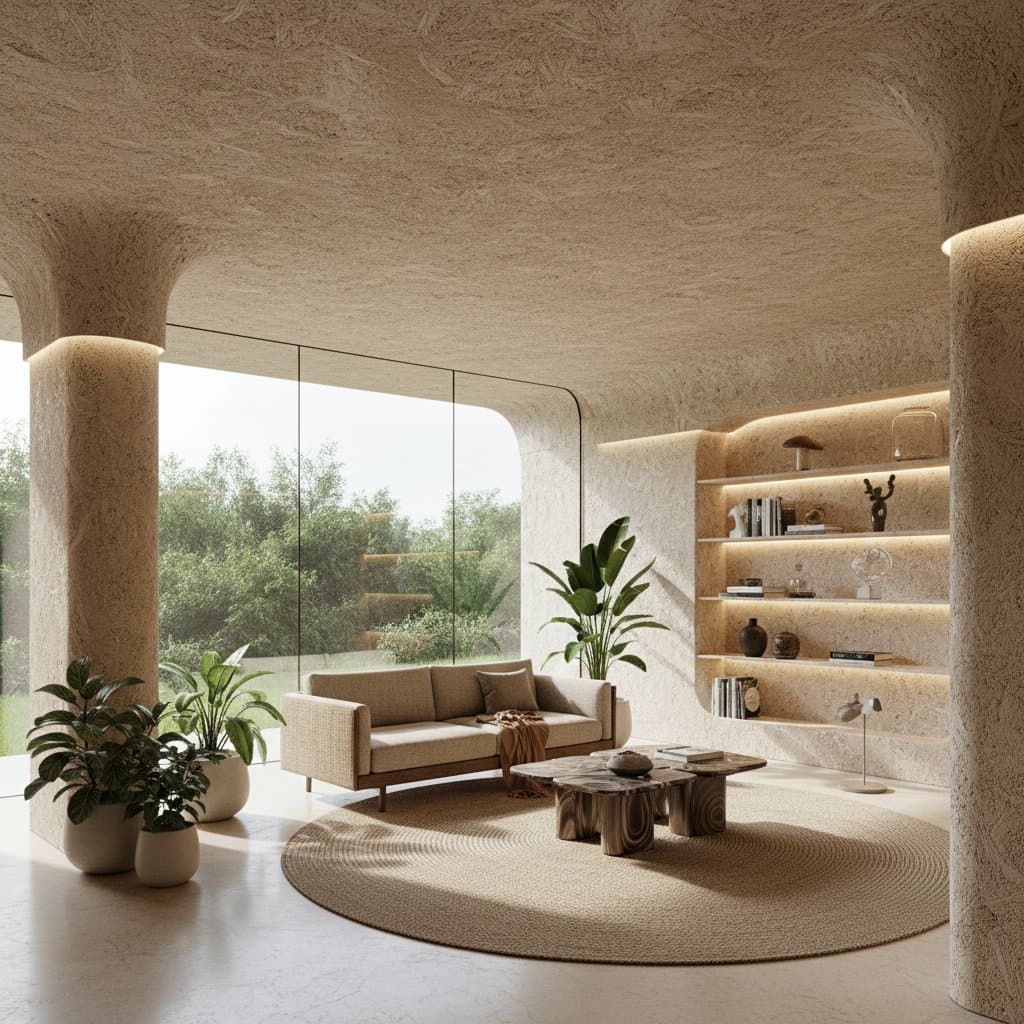
Mycelium in Sustainable Eco-Home Construction
Mushrooms contribute to innovative building practices through their mycelium networks. Architects and engineers utilize this natural resource to develop materials that supplant conventional options in eco-friendly homes. Individuals interested in sustainability, affordability, and improved indoor environments will find this development noteworthy.
Challenges of Traditional Construction Materials
Contemporary homes rely on concrete, steel, and synthetic insulators. Concrete manufacturing generates substantial carbon dioxide emissions, equivalent to about 8 percent of global totals. Steel production demands high energy inputs, and synthetic materials frequently release volatile organic compounds that compromise air quality.
Construction waste accumulates rapidly during projects. Discarded drywall, foam, and wood persist in landfills for extended periods, sometimes centuries. The industry seeks viable alternatives, and mycelium addresses these issues effectively.
Benefits of Mycelium Materials
Mycelium forms a fibrous structure beneath mushroom caps, naturally interconnecting organic substrates. In production, it integrates with waste materials like sawdust or straw within molds to create solid forms. Drying halts growth, yielding stable components suitable for building.
This process mimics natural foam without chemical additives. Mycelium remains renewable, fully compostable, and producible on-site, thereby minimizing transportation emissions and handling risks.
Key Properties of Mycelium for Building
Mycelium exhibits properties that enhance its utility in construction applications.
- Lightweight strength: Supports panels, bricks, and insulation without excessive mass.
- Fire resistance: Achieves ratings comparable to treated wood, independent of synthetic treatments.
- Thermal insulation: Reduces energy needs for climate control by up to 30 percent in tested structures.
- Acoustic absorption: Dampens noise transmission, improving occupant comfort.
- Biodegradability: Decomposes naturally within months in compost conditions.
Production requires minimal energy, avoiding kilns or intensive processing. Growth occurs at ambient temperatures, promoting efficiency.
Production Process for Mycelium Components
The creation of mycelium materials follows a straightforward sequence.
- Prepare substrate: Source and process agricultural residues, such as straw or hemp hurds, into uniform particles.
- Introduce mycelium: Blend substrate with fungal spores in a sterile environment to initiate colonization.
- Form in molds: Compress the inoculated mixture into desired shapes, like insulation boards or structural tiles.
- Facilitate growth: Maintain controlled conditions for 5 to 7 days, allowing mycelium to bind the substrate.
- Stabilize product: Bake at low heat (around 80 degrees Celsius) for 24 hours to deactivate the fungus and finalize the material.
This method utilizes basic equipment, with growth duration varying by strain and environmental factors.
Economic Factors and Availability
Initial perceptions of high costs prove unfounded as scaling occurs. Feedstocks derive from low-value waste, keeping material expenses below those of premium synthetics. Current pricing for mycelium panels aligns with fiberglass alternatives, projected to decrease by 20 to 30 percent within five years.
Savings extend beyond purchase: enhanced insulation lowers utility bills, and reduced waste cuts disposal fees. For bespoke eco-homes, integrate mycelium early in planning to optimize budget allocation.
Advantages and Limitations of Mycelium Use
Evaluate both strengths and drawbacks before adoption.
Advantages:
- Renewable sourcing from abundant waste streams
- Superior insulation for energy savings
- Inherent resistance to fire and pests
- Humidity regulation to prevent mold growth
- Adaptable molding for precise project needs
Limitations:
- Regional supply constraints in non-agricultural areas
- Evolving compliance with international building standards
- Sensitivity to prolonged moisture exposure
- Extended production timelines compared to prefabricated synthetics
Professionals weigh these factors against project goals, often finding mycelium suitable for non-load-bearing elements.
Applications in Eco-Home Projects
Mycelium integrates into diverse construction roles. It serves as wall infill, acoustic panels, and facade elements in completed buildings. Experimental designs employ mycelium composites for load-bearing bricks, tested to withstand compressive forces up to 200 kPa.
Interior applications include grown partitions that insulate and absorb sound without emitting toxins. At project end, these components compost fully, diverting waste from landfills.
Innovative architects develop hybrid systems, pairing mycelium with timber frames for resilient, adaptive homes. Such structures maintain stable indoor climates through natural moisture cycling.
Mycelium Versus Other Sustainable Options
Mycelium distinguishes itself among alternatives like bamboo, hempcrete, and recycled plastics.
- Rapid development: Completes in days, unlike bamboo's seasonal harvest.
- Low energy input: Requires no drying ovens, contrasting with hempcrete curing.
- Full recyclability: Degrades without residue, surpassing many composites.
- Design versatility: Forms complex geometries on-site, minimizing fabrication waste.
Combinations with complementary materials enhance overall performance, such as adding fibers for tensile strength.
Practical Implementation Guidelines
Incorporate mycelium thoughtfully to ensure success.
- Regulatory compliance: Verify local codes; provide lab-tested data on strength and durability for approvals.
- Moisture management: Apply breathable barriers to protect against condensation in humid climates.
- Fire performance: Select strains certified to ASTM E84 standards for interior use.
- Load considerations: Limit to secondary structures; reinforce with metals or woods for primary supports.
Engage contractors experienced in biobased materials. They can source certified products and integrate them seamlessly.
Home-Based Mycelium Experiments
Amateur builders can experiment with small-scale production. Purchase kits containing spores, substrates, and instructions for items like shelving or decorative panels.
Maintain sterility during inoculation to avoid contamination. Dry thoroughly post-growth to ensure stability. These trials build practical knowledge for larger endeavors.
Advancements in Mycelium Technology
Research accelerates mycelium's viability. Institutions develop strains with enhanced water resistance and mechanical properties through genetic selection. Commercial facilities now produce tons annually, supporting broader adoption.
Collaborations between academia and industry yield innovations, such as mycelium-infused plasters for seamless integration.
Benefits of Residing in Mycelium-Enhanced Homes
Occupants experience tangible improvements in a mycelium-integrated home. Air quality rises due to absent chemical emissions, and thermal performance stabilizes temperatures year-round.
Structures age organically, requiring less upkeep than synthetic counterparts. Energy reductions translate to annual savings of hundreds in heating costs, fostering long-term sustainability.
Steps to Integrate Mycelium in Your Build
Begin by identifying project needs, such as insulation upgrades or non-structural panels. Consult suppliers for samples and specifications, including R-values for insulation efficacy.
Collaborate with designers to prototype sections, testing fit within overall plans. Layer with compatible elements like natural plasters for cohesive results.
This approach not only minimizes environmental impact but also elevates living standards through innovative, responsive materials.