
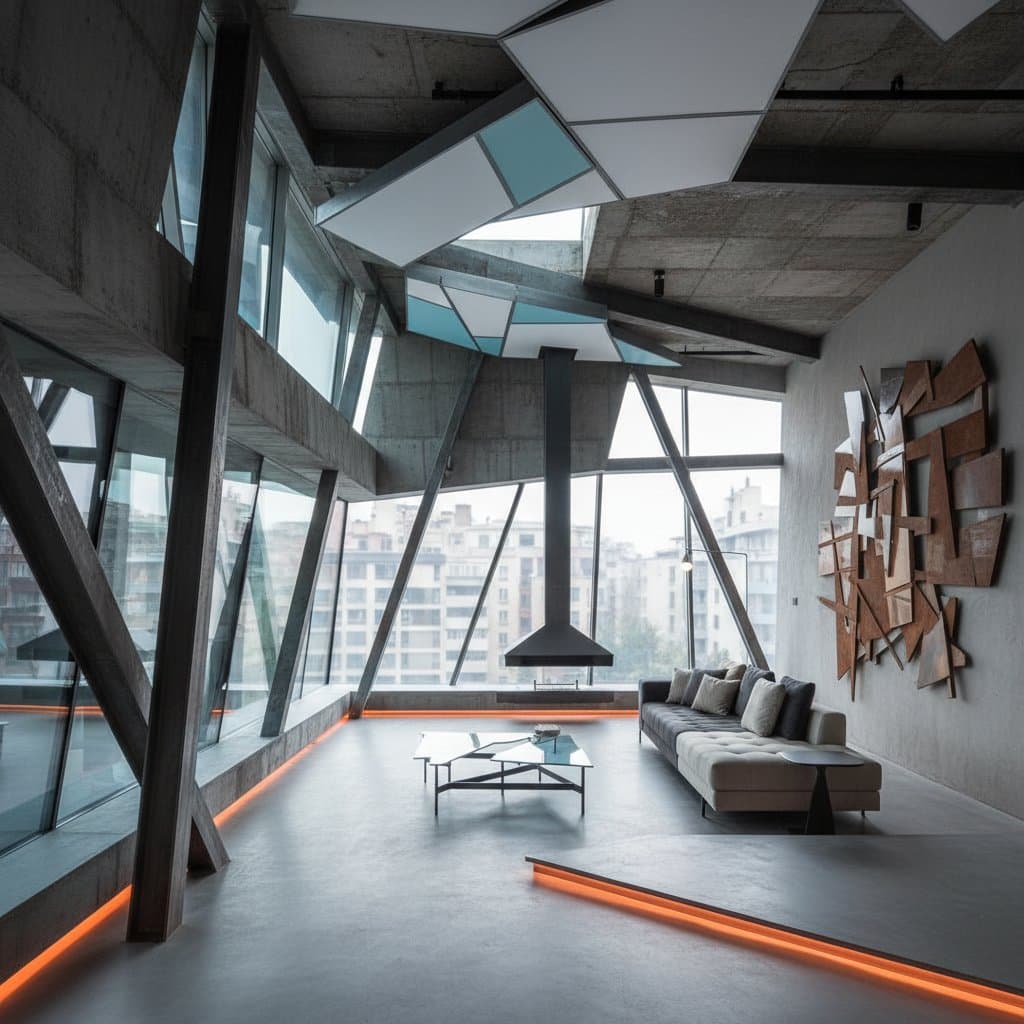
Embracing Chaos: Deconstructivism's Rise in 2026 Homes
Consider a home where uneven angles and fragmented geometry create a sense of vitality. This intentional imperfection defines deconstructivism, a style gaining traction among homeowners who seek designs that pulse with energy. Unlike the precise lines of minimalism or the familiarity of traditional modern architecture, deconstructivism introduces raw creativity through asymmetrical forms and exposed elements, making spaces feel dynamic and personal.
Homeowners drawn to artistic expression find deconstructivism transformative. It elevates ordinary residences into sculptural environments that provoke thought and conversation, appealing to those ready to prioritize individuality over convention.
What Deconstructivism Really Means
Deconstructivism emerged in architecture as a deliberate rejection of rigid order, favoring fragmented shapes, intersecting planes, and clashing materials. Structural elements remain visible, emphasizing process over concealment, while deliberate imbalances generate intrigue rather than harmony.
In residential applications, this translates to walls converging at unconventional angles, windows suspended in asymmetrical arrays, and staircases curving unpredictably. The approach celebrates tension between form and function, revealing beauty in disruption without descending into disorder.
Visualize dismantling the conventional rectangular home and reassembling it with provocative juxtapositions. This results in spaces that appear bold, innovative, and subtly defiant, inviting occupants to engage with architecture on a deeper level.
Why Homeowners Are Drawn to It
Homeowners select deconstructivism for its capacity to embody unique identities. In an era of standardized designs, this style offers distinction, allowing irregular contours and raw textures to mirror personal narratives of innovation and boldness.
These homes convey authenticity, evoking a sense of habitation rather than display. Advanced materials such as high-strength steel, tempered glass, and reinforced concrete enable intricate configurations that enhance durability while amplifying aesthetic impact.
Builders leverage these innovations to craft forms previously deemed impractical, reducing barriers to adoption. As a result, deconstructivism aligns with contemporary desires for environments that inspire rather than conform.
The Look and Feel of a Deconstructivist Home
Entering a deconstructivist home reveals constant motion through shifting walls and refracted light. Spatial arrangements guide movement intuitively, yet surprise with their fluidity, fostering an atmosphere of perpetual discovery.
Key features contribute to this immersive experience:
- Angular forms that disrupt rectilinear patterns, creating dynamic room divisions.
- Mixed materials such as weathered concrete alongside polished wood or frosted glass abutting brushed metal.
- Exposed structure featuring visible trusses, riveted joints, or ductwork that add industrial texture.
- Fragmented facades resembling abstract sculptures, with protruding volumes and recessed planes.
- Layered lighting that accentuates contours, casting elongated shadows to deepen spatial drama.
Together, these elements underscore the philosophy that irregularity fosters profound aesthetic appeal.
How to Bring Deconstructivism into Your Home
Incorporating deconstructivist principles requires no full-scale reconstruction. Targeted modifications can infuse existing spaces with the style's essence, starting with accessible elements.
1. Start with Geometry
Introduce asymmetrical shapes via select furnishings or accents. Opt for a side table with cantilevered legs or a wall-mounted shelf featuring offset tiers, integrating subtle disruption without structural alterations.
2. Expose the Structure
During renovations, uncover foundational components like ceiling joists or support columns. Apply a clear sealant to raw steel I-beams or polished concrete pillars, enhancing their tactile presence while ensuring longevity.
3. Mix Materials
Juxtapose textures for deliberate contrast: install a concrete accent wall beside reclaimed timber paneling, or use metal mesh screens to divide areas from glass dividers. This interplay generates visual energy that defines the aesthetic.
4. Experiment with Color
Anchor the palette in neutrals like exposed aggregate grays, then introduce accents to emphasize fractures. Select matte charcoal for trim against ivory walls, or vibrant ochre to spotlight angular niches, amplifying geometric intrigue.
5. Play with Light
Strategic illumination transforms architecture. Position adjustable track lights to graze edges, or embed linear LEDs along joints, creating rhythmic glows. Incorporate clerestory windows to allow diffused daylight that evolves with the sun's path.
The Realities: Cost, Effort, and Complexity
Deconstructivism demands investment due to its non-conventional demands. Custom engineering for atypical geometries and sourcing specialty finishes elevate expenses beyond standard projects.
- Design costs: Engage specialists whose portfolios include parametric modeling; budgets often exceed traditional plans by 20 to 50 percent, depending on scale.
- Construction time: Schedules extend by 15 to 30 percent as teams navigate precise tolerances for interlocking components.
- Maintenance: Vulnerable surfaces require annual treatments, such as anti-corrosion coatings for metals or efflorescence removal from concrete.
Mitigate expenses by phasing implementations, focusing on high-impact zones like entryways. Interior adaptations, including modular partitions, deliver stylistic benefits at lower thresholds.
Pros and Cons to Think About
Evaluating deconstructivism involves balancing its allure against practicalities.
Pros:
- Offers unparalleled personalization through bespoke forms.
- Delivers striking visual narratives that differentiate from neighbors.
- Maximizes material efficiency in innovative applications.
- Enhances illumination via strategic apertures, promoting energy savings.
Cons:
- Incurs premium pricing for bespoke fabrication.
- Poses resale challenges in markets favoring symmetry.
- Complicates furniture integration amid non-orthogonal spaces.
- Necessitates ongoing care for weather-exposed features.
Long-term residents benefit most from its enduring inspiration, while modular elements preserve adaptability for future transitions.
Working with Professionals
Success hinges on collaborating with experts versed in deconstructivist techniques. Seek architects proficient in computational design tools, which simulate complex assemblies for feasibility.
Review portfolios for projects featuring tensile structures or faceted envelopes. Verify credentials through professional associations to ensure compliance with seismic and load-bearing standards.
Anticipate regulatory hurdles by consulting local codes on height variances or material approvals. Involve your team in permitting processes to streamline approvals and avert delays.
Everyday Comfort in a Deconstructivist Space
Thoughtful execution ensures deconstructivist homes remain habitable. Functional zoning maintains accessibility, with pathways accommodating standard clearances despite visual complexity.
Incorporate softening agents like plush area rugs over hard floors or diffused pendants to temper stark lines. Curved upholstery balances angular architecture, cultivating warmth amid boldness.
Treat the environment as interactive sculpture: daily interactions reveal evolving perspectives, particularly as sunlight animates surfaces throughout the day.
Maintaining Your Investment
Preserve deconstructivist integrity through routine protocols.
- Seal exposed surfaces with penetrating sealers quarterly to repel moisture and contaminants.
- Inspect joints and edges biannually, addressing caulk degradation or fastener loosening promptly.
- Update lighting every two years, replacing fixtures to align with advancing LED efficiencies.
- Clean glass panels weekly with non-abrasive solutions, preserving transparency that enhances reflective qualities.
Consistent attention sustains the design's precision and vitality over decades.
Living with a Fragmented Design
Deconstructivism nurtures an appreciation for flux. Shadows shift to unveil hidden facets, while light reveals layered depths in familiar rooms.
For those who thrive in environments that defy routine, this approach sustains inspiration. It reimagines shelter as a canvas for worldview, where fragmentation signifies vitality rather than flaw.
Initiate with incremental enhancements or pursue comprehensive redesigns to infuse motion and uniqueness. Deconstructivism redefines domesticity, proving that releasing conventional constraints unlocks profound spatial potential.