
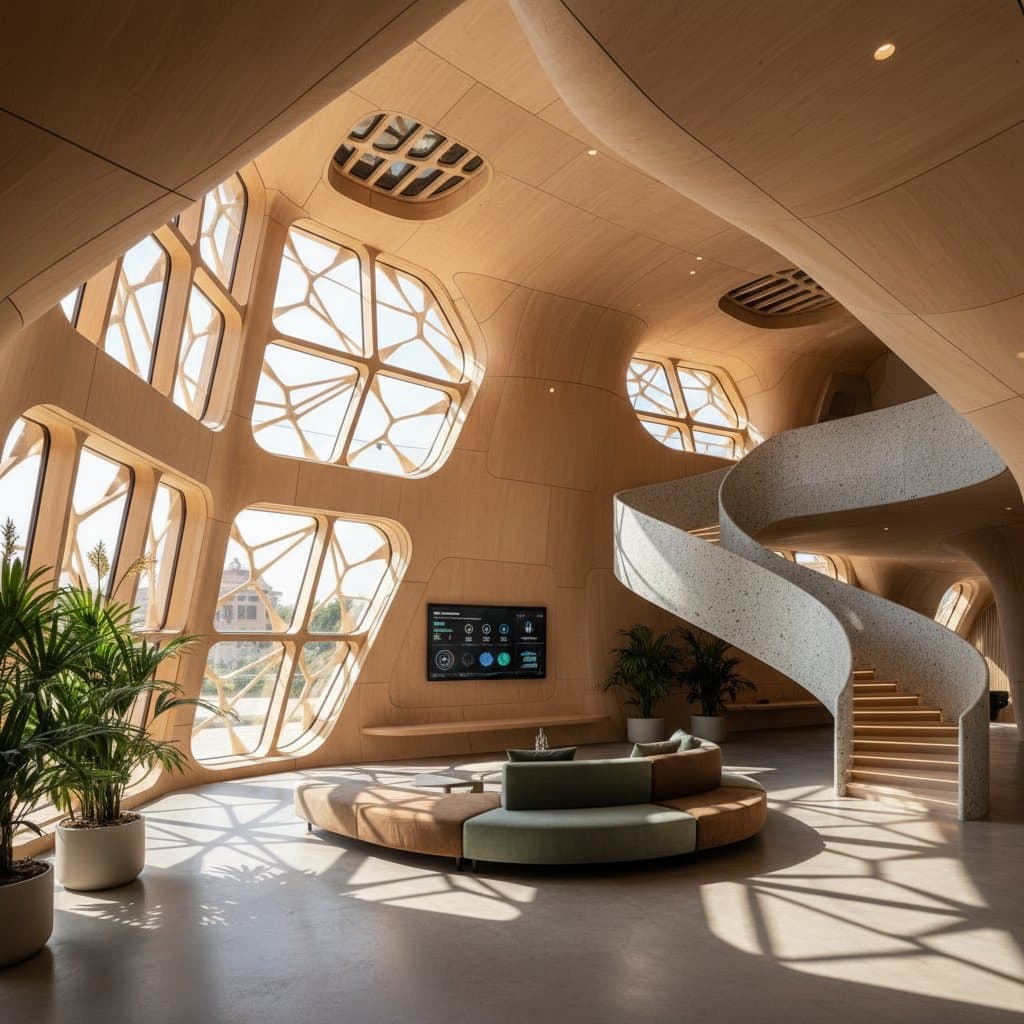
Algorithmic Homes: Parametric Design’s 2026 Revolution
You may have encountered images of futuristic homes featuring fluid walls, adaptable floors, and windows that respond to shifting light. Such designs raise questions about their feasibility. The answer lies in mathematics, not fantasy. Enter the era of algorithmic homes, where parametric design reshapes architectural principles.
Picture a residence that modifies its form to follow the sun’s path, or a living area that enlarges for visitors and shrinks for intimate moments. These concepts emerge from computational architecture, altering perceptions of residential spaces.
From Blueprint to Algorithm
Conventional design relies on sketches and fixed blueprints. Parametric design reverses this method. Architects establish parameters that outline connections among elements such as form, framework, and materials. Software algorithms then generate numerous iterations to identify optimal configurations.
Consider this process akin to encoding a home’s genetic blueprint. Alter a single factor, like sunlight exposure, and the structure transforms accordingly. This adaptability empowers parametric design, particularly for residences that accommodate evolving lifestyles, weather patterns, and aesthetic preferences.
The Rise of Algorithmic Homes
Algorithmic homes apply these computational guidelines to physical settings. Each contour, partition, and aperture derives from a mathematical framework that harmonizes functionality and elegance. The outcome is architecture that appears dynamic.
The strength rests in integrating creativity with accuracy. Examples include:
-
Climate-adaptive exteriors that regulate temperature and illumination.
-
Flexible interiors that reconfigure for remote work areas, fitness spaces, or social events.
-
Resource-optimized materials where components fulfill specific roles, minimizing excess and expenses.
Beyond appearance, these homes interact with surroundings. They analyze environmental inputs to enhance occupant comfort and energy efficiency in manners unattainable by conventional buildings.
How Parametric Design Works
Parametric design appears intricate, yet it centers on interdependencies. Professionals input parameters into dedicated software, which outputs forms satisfying the specified requirements. For instance, directing the system to optimize natural light while curbing thermal influx could yield a roof with precise curvature, permitting illumination without overheating interiors.
The workflow unfolds as follows:
-
Establish parameters: Factors range from regional airflow to spatial dimensions or financial constraints.
-
Produce alternatives: Algorithms yield multiple variants compliant with the inputs.
-
Assess outcomes: Stakeholders examine selections to align with intended goals.
-
Iterate and construct: The chosen prototype translates into comprehensive building plans.
This methodology eliminates speculation, substituting it with evidence-based exactness. It unlocks innovative forms beyond manual techniques.
Sustainability Through Computation
Algorithmic homes excel in environmental stewardship. Parametric simulations process climatic information to refine layouts for passive airflow, superior thermal barriers, and judicious material selection. A seaside dwelling might incorporate sinuous barriers to redirect gusts, whereas a highland lodge could employ slanted glazing to harness solar warmth.
Such analysis curtails pre-build inefficiencies. Procurement matches precise volumes, and techniques like additive manufacturing or computer-numerical-control machining deliver millimeter-level accuracy. Consequently, structures achieve superior performance and durability, with reduced expenditures and ecological footprints.
The Human Touch in Digital Design
Algorithms manage intricacies, but human insight proves indispensable. Designers analyze metrics, assign emphases, and guarantee the end product evokes habitation over mechanism. Superior algorithmic homes fuse analytical prowess with sensory appeal.
Envision entering a domain where surfaces mirror daily routines. Dawn rays penetrate self-opening louvers, while dusk casts patterns on computationally sculpted planes. Technology integrates seamlessly, fostering serenity, ease, and connection. Thoughtful oversight realizes parametric design’s potential.
Practical Considerations for Homeowners
For those contemplating parametric features in upcoming builds, key aspects warrant attention:
-
Budget: While cost-effective overall, preliminary simulations and tools may elevate initial outlays. View these as commitments to enhanced efficiency and enduring economies.
-
Technology integration: Residences frequently embed monitoring for consumption or illumination control. Verify contractors possess expertise in structural and electronic facets.
-
Permits and compliance: Regulations differ regionally, and some authorities lack familiarity with computational forms. Engage specialists adept at converting models into sanctioned drawings.
-
Maintenance: Sensor-dependent elements require upkeep. Schedule regular servicing and assistance to sustain operations.
Real-World Examples
Contemporary practitioners employ parametric methods to develop responsive environments. Residences often display grid-like shells mimicking foliage to modulate daylight. Alternative designs utilize relocatable sections for seclusion or circulation. This methodology extends to educational facilities, cultural venues, and public assemblies, demonstrating its versatility in utility and aesthetics.
Regional constructors increasingly integrate parametric software for bespoke projects. Collaborate with experts who demonstrate real-time impacts, such as roof inclinations on efficiency or fenestration on luminosity. Such visibility enables decisions attuned to finances, locale, and habits.
The Future of Living Design
Technological progress will democratize algorithmic homes. Online platforms facilitate global, instantaneous teamwork, and fabrication innovations simplify intricate geometries. Boundaries between creators and users dissolve as intuitive controls empower personal adjustments.
Customizing spatial arrangements may soon parallel device configurations. Surfaces could retain acoustic preferences, or culinary zones adapt for assemblies. Parametric approaches enable residences that progress alongside inhabitants, eschewing rigidity.
Steps to Implement Parametric Design
To pursue computational architecture for your venture, seek collaborators versed in artistic vision and modeling expertise. Platforms like doricsouth.com offer free project postings to connect with qualified builders specializing in parametric execution.
Future dwellings transcend immobility. They serve as perceptive allies, informed by analytics, shaped by ingenuity, and aligned with personal rhythms. Initiate the shift toward intelligent construction today.