
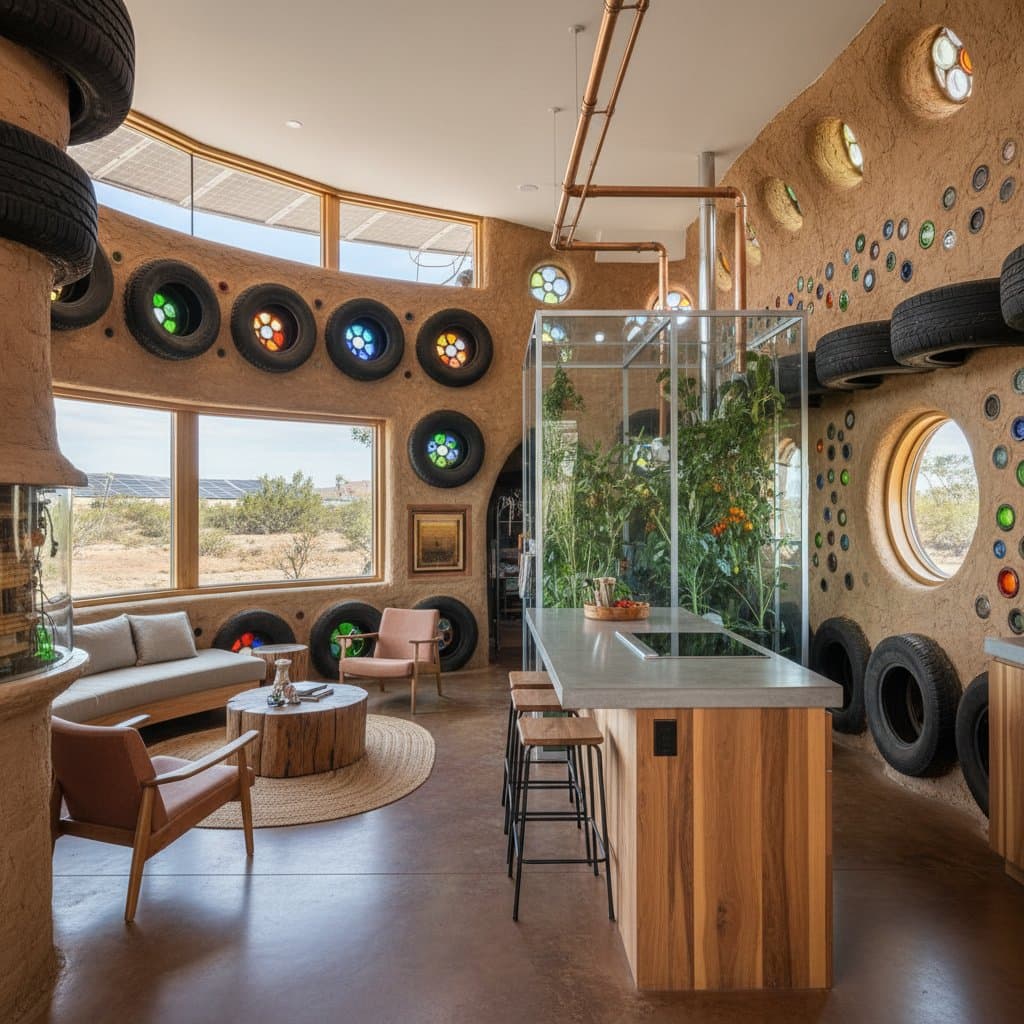
Earthships Rising: Tire Homes for Radical Sustainability
Consider a stack of discarded tires transforming into sturdy home walls. This concept forms the foundation of Earthships, innovative structures driving a movement toward extreme sustainability. These homes incorporate recycled materials, capture rainwater for use, and support indoor food production. For individuals seeking off-grid independence or reduced utility expenses, Earthships illustrate the potential of combining thoughtful design with resourceful practices.
Why Earthships Are Catching Attention
Conventional residences depend on external networks for climate control and water supply. Earthships reverse this approach by addressing most requirements internally. The dense tire walls provide superior thermal mass, retaining heat in winter and deflecting summer warmth. Roof-collected rainwater undergoes filtration for potable use, while solar arrays supply electricity. Graywater from fixtures nourishes integrated planters.
Such autonomy appeals to those facing escalating energy prices and climate variability. Constructing or acquiring an Earthship demands significant effort, yet the enduring benefits in efficiency and livability justify the investment. This model extends beyond novelty; it promotes intelligent utilization of available resources.
What Makes an Earthship Different
Earthships rely on natural and repurposed elements for construction. Discarded tires, aluminum cans, and glass bottles integrate into the framework, diverting waste from landfills. The architecture emphasizes passive solar principles, with earthen-filled walls absorbing daytime heat for nighttime release and facilitating natural airflow for cooling.
Each Earthship integrates six essential systems:
- Thermal and solar heating and cooling through wall mass and strategic venting.
- Solar and wind electricity generation to power appliances and lighting.
- Rainwater harvesting and filtration for storage and purification.
- On-site sewage management via constructed wetlands.
- Integrated food production in south-facing greenhouses and planters.
- Upcycled materials throughout the build to minimize resource use.
These components enable the home to operate in diverse locations with minimal grid reliance.
How to Start Building Your Own
Individuals interested in constructing an Earthship can commence with modest projects. The endeavor requires thorough preparation, persistence, and physical effort. Follow these steps to proceed systematically.
- Conduct research and develop a design. Study various floor plans, assess local climate impacts, and review zoning regulations. Unconventional materials may necessitate variance approvals.
- Select an appropriate site. Prioritize areas with ample solar access and effective drainage. A south-facing incline optimizes passive heating.
- Source materials. Obtain tires gratis from tire retailers or recycling centers. Collect cans, bottles, and sufficient soil for compaction.
- Construct the foundation and tire walls. Ram earth into each tire using a pneumatic tamper for structural integrity. This phase demands teamwork due to its intensity.
- Incorporate framing and roofing. Employ salvaged lumber or steel for support. Design the roof with a 30-degree pitch to maximize rainwater capture.
- Integrate utility systems. Mount solar panels on the roof, install cisterns for water storage, and set up multi-stage filters. Begin with core elements and upgrade progressively.
- Complete the interior finishes. Apply natural plasters, polish concrete floors, and use reclaimed fixtures to maintain an organic aesthetic.
A compact Earthship may require three to six months of part-time labor, varying by crew size and weather conditions. Engage certified experts for wiring and plumbing to ensure compliance and safety.
Budget and Practical Considerations
Earthships often prove cost-effective relative to stick-built houses, particularly with owner involvement. A basic 400-square-foot model might total $50,000 in materials and labor, comparable to a used car, while expansive versions approach $200,000. Post-construction, the absence of monthly bills for power and water yields rapid returns.
Key factors include:
- Regulatory approvals: Verify that local authorities accept tire-based construction; appeals processes can extend timelines.
- Workforce needs: Compacting 500 tires requires 200-300 person-hours; recruit community support or hire laborers.
- Site logistics: Isolated properties enhance seclusion but increase transport costs for supplies.
- Ongoing upkeep: Inspect photovoltaic arrays annually and flush water systems quarterly to sustain performance.
- Market dynamics: Demand for Earthships rises in eco-communities, yet broader resale options remain developing.
Despite hurdles, the resulting autonomy fosters empowerment and ecological stewardship.
Living in an Earthship Day to Day
Daily existence in an Earthship diverges from typical housing. Indoor temperatures stabilize between 65 and 75 degrees Fahrenheit year-round, courtesy of passive systems. The greenhouse not only purifies air but yields tomatoes, greens, and herbs with minimal external inputs.
Residents adapt to routines like monitoring cistern levels during dry spells or charging batteries via wind backups. Most report heightened satisfaction from this symbiotic relationship with their environment. One resident shared: “You learn to live with your home, not just in it.”
Advancing Toward Your Earthship
To pursue an Earthship, tour existing installations or attend hands-on seminars. Observe operational systems firsthand to gauge suitability for your circumstances. Initiate with auxiliary builds, such as a tire-walled shed, to acquire skills before scaling up.
This path suits committed builders, revealing innovative ways to harmonize with nature. By converting tires into thermal barriers and harnessing rain for renewal, Earthships deliver resilient habitats that lower footprints and enhance well-being.