
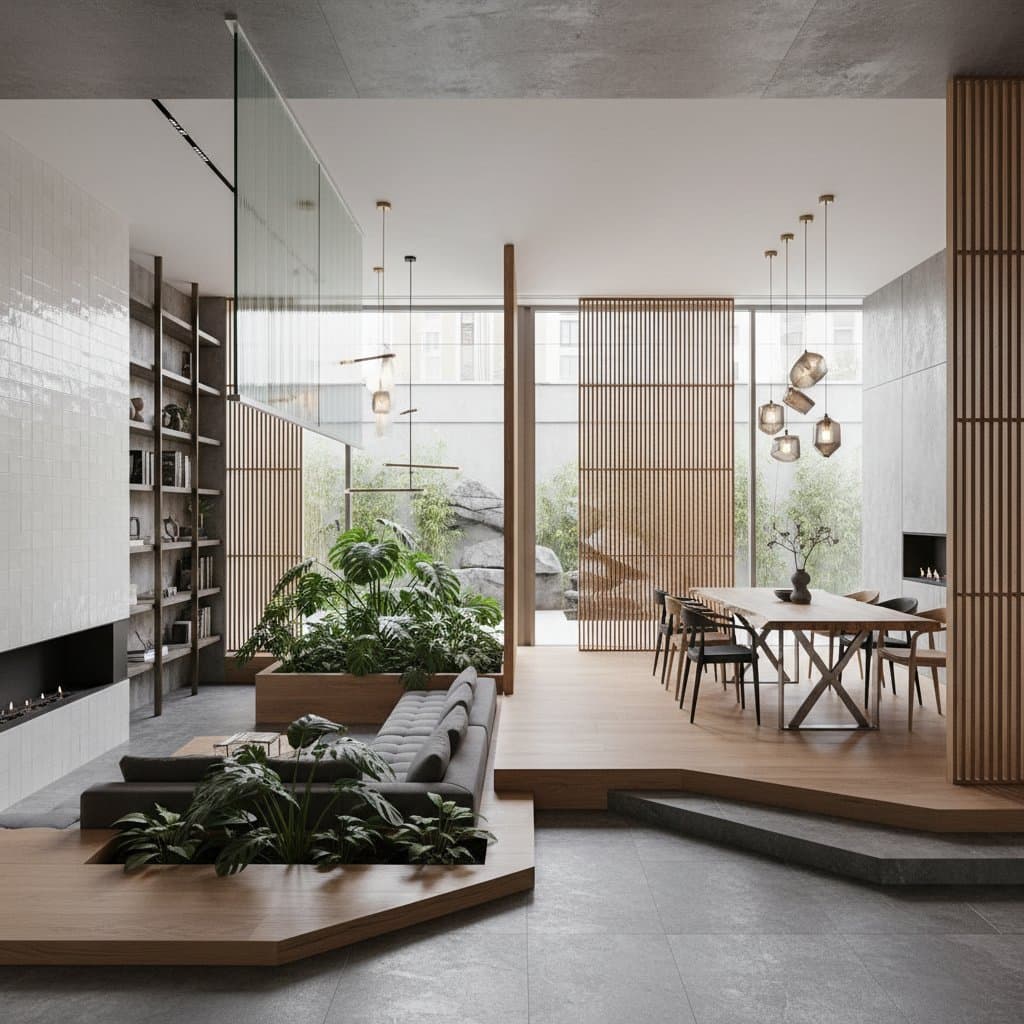
How Fragmented Spaces Redefine Modern Interiors
Readers may have observed that contemporary homes and apartments increasingly depart from rigid room divisions. Partial walls dissolve boundaries, corners reveal surprising vistas, and areas blend seamlessly. This intentional design strategy, known as fragmented space, introduces broken forms, layered transitions, and purposeful disconnection to infuse interiors with vitality and adaptability.
Moving Beyond Traditional Symmetry
Traditional home layouts emphasized balance and enclosure, with rectangular living rooms, concealed kitchens, and linear hallways forming a structured grid. While such arrangements retain appeal in certain contexts, they often appear restrictive in today's fast-paced world. Modern preferences prioritize fluidity and personalization over predictability.
Fragmented interiors address this evolution through asymmetry, permeable dividers, and fluid shifts. Rather than uniform expanses, spaces divide into distinct yet interconnected zones that alter in scale or purpose. For instance, a sunken lounge might transition into an elevated workspace via a low partition, or a mezzanine overlook could connect a bedroom to a communal area. These elements imbue the environment with a sense of progression and responsiveness.
Reasons Designers Favor Fragmentation
Interior professionals highlight fragmentation's capacity to inject energy and individuality into spaces. Layered divisions and varied textures draw the eye, revealing how illumination interacts with surfaces or how finishes juxtapose. This dynamic quality sustains visual engagement without overwhelming the senses.
Key advantages include:
- Adaptability: Configurations evolve with life stages; rearrange partitions or repurpose nooks without extensive alterations.
- Depth and intrigue: Uneven geometries and diverse materials generate layered perspectives, transforming static rooms into immersive narratives.
- Balanced proximity: Zones maintain interaction while affording seclusion, allowing activities like meal preparation or focused tasks to coexist harmoniously.
- Individuality: Each offset element or irregular contour conveys unique intent, liberating designs from conventional templates.
Connections to Deconstructivist Principles
Fragmented interiors draw from deconstructivist architecture, which dismantles notions of uniformity to expose underlying structures. This philosophy favors intentional fragmentation over concealment, with tilted partitions, intersecting planes, and deliberate dislocations. The aim remains ordered tension rather than disarray.
In residential settings, applications manifest as:
- Suspended staircases that segment areas without enclosing them fully.
- Dropped or vaulted ceilings that modulate illumination across zones.
- Varied elevations, such as platform seating, that delineate functions subtly.
- Angular motifs and asymmetrical forms that distinguish each segment.
These features establish a palpable cadence, evoking motion amid stillness and elevating everyday spaces to thoughtful compositions.
Advantages and Drawbacks of Fragmented Layouts
Every design paradigm presents trade-offs, and fragmentation proves no exception. Weighing these factors ensures alignment with practical needs.
Advantages:
- Vital atmosphere: Areas interconnect while retaining identity, fostering a cohesive yet varied home.
- Tailored efficiency: Arrangements accommodate actual routines rather than imposing rigid frameworks.
- Enhanced ventilation: Reduced barriers promote airflow and daylight penetration.
- Expressive freedom: Combine disparate motifs without symmetry constraints.
Drawbacks:
- Acoustic challenges: Permeable separations amplify sound transmission.
- Climate control issues: Expansive areas complicate uniform heating or cooling.
- Furnishing demands: Non-standard contours necessitate bespoke or ingeniously positioned pieces.
- Organizational hurdles: Limited enclosures heighten the need for strategic concealment.
Thoughtful mitigation, such as acoustic panels or zoned climate systems, preserves benefits while addressing limitations.
Incorporating Fragmentation Practically
Achieving fragmented aesthetics requires no wholesale overhaul. Incremental modifications yield comparable effects of interconnection and nuance.
Employ Subtle Partitions
Opt for low barriers like pony walls, modular screens, or perforated panels to delineate without isolating. Position a freestanding cabinet between a lounge and entryway to guide movement while preserving openness.
Integrate Textural and Elevational Shifts
Signal transitions through material variances, such as shifting from carpeted warmth to sleek stone underfoot, or from soft fabrics to reflective metals. A single riser or recessed platform can subtly demarcate a meditation alcove from adjacent circulation paths.
Layer Multifunctional Elements
Design features for dual roles, like an island that functions as workspace and buffet, or built-in seating that conceals linens. Such overlaps streamline utility and enrich spatial dialogue.
Harness Illumination for Zoning
Deploy targeted fixtures—chandeliers over tables, task lamps in corners—to sculpt atmospheres and imply divisions. Recessed cove lighting along edges can softly delineate pathways without physical intrusion.
Preserve Visual Continuity
Maintain unobstructed lines of sight to reinforce unity. Translucent dividers or minimalist railings ensure fragmented elements enhance rather than fragment the overall harmony.
Essential Planning Factors
Initiate changes with a comprehensive evaluation to maximize efficacy.
Financial Aspects:
Affordable tweaks, including rugs or repositioned accents, incur minimal cost. Extensive modifications involving bespoke joinery or material sourcing demand greater investment; allocate accordingly for durability.
Timeline and Logistics:
Cosmetic adjustments complete swiftly over weekends, whereas load-bearing alterations require professional oversight and regulatory approvals, extending durations.
Expert Guidance:
Engage specialists in progressive architecture to refine concepts into viable plans. Structural interventions warrant licensed contractors to uphold integrity.
Safety Measures:
Exposed frameworks invite hazards; select blunt-edged fixtures and shatter-resistant glazing to safeguard occupants.
Upkeep Strategies:
Diverse substrates demand varied regimens—dust wood grains gently, wipe metals promptly. Select low-maintenance options to simplify routines.
Harmonizing Intricacy and Ease
Fragmentation thrives when tempered with restraint to avoid disorientation. Anchor elaborate sections with serene counterparts; pair an angular gallery wall with streamlined cabinetry. This equilibrium sustains habitability alongside innovation.
View the layout as an orchestrated sequence, where motifs recur subtly—a shared hue threading disparate zones or consistent grain patterns unifying shifts. Such cohesion elevates fragmentation from experiment to enduring sanctuary.
Experiencing Fragmented Environments Daily
Implemented fragmentation alters routines profoundly, revealing overlooked potentials like sunlit ledges for impromptu gatherings or shadowed recesses for solitude. Daily light variations accentuate contours, prompting fresh interactions with familiar surroundings.
Initial perceptions of incompleteness fade as the design's adaptability shines. Periodic refinements—swapping accents or recalibrating zones—ensure ongoing relevance, embodying the style's core resilience.
Steps to Implement Fragmentation
Commence modestly: Reconfigure existing elements to test boundaries, such as angling a sofa to imply seclusion. Introduce permeable storage to soften transitions, or layer rugs to evoke elevation changes. Observe interactions over time, refining iteratively to align with personal cadence and cultivate a home that resonates intuitively.