
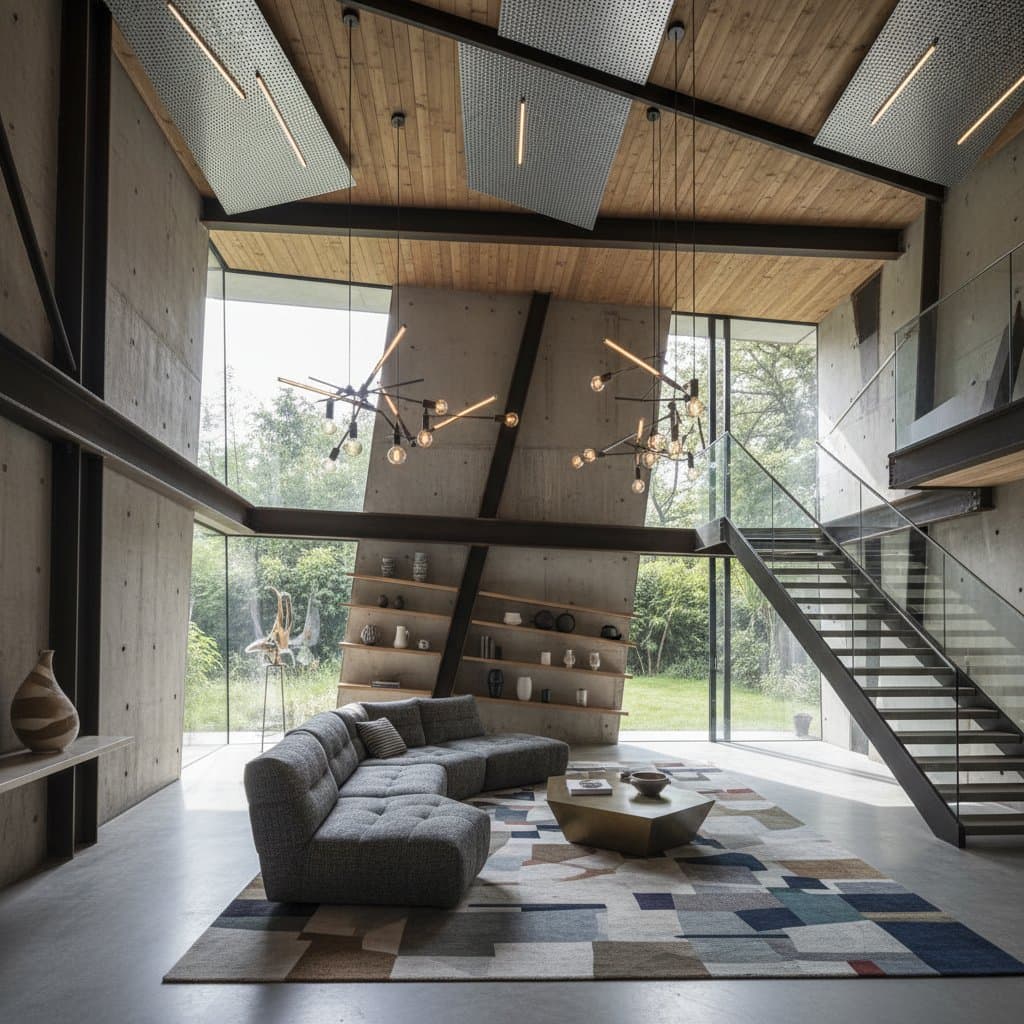
Deconstructivist Design Enters Mainstream Homes
Homeowners may observe deconstructivist elements in contemporary residences, boutique accommodations, or neighborhood cafes. Features include walls that diverge from alignment, staircases that appear suspended, and furnishings that challenge conventional form while maintaining equilibrium. This design philosophy, previously confined to experimental realms, permeates standard living areas. What originated as an avant-garde architectural paradigm now redefines perceptions of spatial organization and construction.
Origins: From Architectural Challenge to Residential Adoption
Deconstructivism emerged as a deliberate opposition to conventional symmetry and uniformity in architecture. Rather than pursuing harmony and predictability, it embraces irregularity, fragmentation, and inherent tension. This approach yields a visual narrative that conveys dynamism, occasional disarray, and remarkable habitability when executed thoughtfully.
Historically, deconstructivism appeared in galleries, temporary exhibits, and upscale commercial venues. Contemporary residents integrate its striking geometries and unadorned materials to craft environments that reflect individual narratives. This evolution mirrors a broader acceptance of asymmetry and flaw, as individuals seek interiors that prioritize genuineness over excessive refinement.
Reasons for Its Appeal in Residential Settings
Several factors explain the rising popularity of deconstructivist principles in homes.
-
Personalized Articulation
Distinctive deconstructivist interiors avoid uniformity. Each arrangement discloses the resident's preferences via unconventional angles, surprising contours, and inventive material applications. This method allows expression of character independent of ephemeral fashions. -
Dynamic Visual Flow
Rectilinear forms and absolute equilibrium often appear stagnant. Deconstructivist elements introduce motion, invigorating the atmosphere. Simple interventions, such as an inclined bookcase or offset tile patterns, infuse energy into otherwise conventional areas. -
Authentic Material Use
Deconstructivist environments accentuate unprocessed substances like poured concrete, exposed metal, transparent glass, and salvaged timber. These selections expose tactile qualities and profundity, fostering a sense of stability that resonates with contemporary ecological priorities. -
Versatile Implementation
Although visually assertive, deconstructivism accommodates diverse financial constraints and property configurations. Incorporation ranges from subtle enhancements in isolated zones to comprehensive overhauls involving foundational alterations.
Incorporating Deconstructivism into Residential Spaces
Individuals interested in adopting this aesthetic should commence with modest modifications, emphasizing deliberate selections over haphazard alterations. The objective involves generating controlled visual discord that achieves cohesion rather than disorder.
1. Emphasize Structural Elements.
Enhance openness by eliminating non-essential partitions or modifying overhead clearances. Revealing support timbers and structural frameworks underscores the edifice's framework, echoing deconstructivism's emphasis on openness in construction.
2. Experiment with Geometric Forms.
Introduce inclined partitions, bespoke storage units, or asymmetrical fenestration to depart from orthodox shapes. A subtly angled balustrade or cabinetry featuring displaced facades can convey the essence without extensive rebuilding.
3. Integrate Varied Textures.
Blend refined and coarse finishes for depth. Consider a sleek concrete substrate alongside untreated metal highlights or organic lumber accents to produce a multifaceted impression that unites modernity with inviting warmth.
4. Strategize Illumination.
Targeted illumination accentuates disparities in textures and silhouettes. Embedded luminaires, rail-mounted systems, and elongated light-emitting diodes delineate acute contours and unforeseen facets central to deconstructivist expression.
5. Select Sculptural Furnishings.
Opt for items exhibiting non-conformist profiles or artistic contours. A pedestal with irregular support or seating positioned eccentrically serves as a focal point without dominating the environs.
Essential Practical Aspects
Financial Planning and Expenses
Expenses for deconstructivist applications vary by scope. Incremental enhancements, including illumination, surface treatments, and movable pieces, typically span $5,000 to $15,000 for a standard communal zone. Extensive foundational modifications commence around $50,000, particularly when involving partition adjustments or tailored structural features. Non-symmetrical configurations frequently demand expert craftsmanship, elevating both supply and planning expenditures.
Regulatory Compliance and Stability
Alterations to barriers, overhead configurations, or load-bearing components necessitate consultation with certified builders or engineering specialists. Elements such as elevated treads or projecting segments adhere to rigorous standards. Authorizations prove essential for such modifications, irrespective of ornamental intent.
Duration and Complexity
Allocate weeks for conceptual development and additional months for execution if foundational tasks arise. Minor decorative adjustments conclude within a month. Complexity fluctuates, yet residents generally engage specialists for skeletal work, wiring, and detailing, given the precision required for oblique and superimposed assemblies.
Geographic Variations
Metropolitan contexts favor industrial interpretations with bare concrete and ferrous elements. Peripheral locales soften the approach, merging imbalance with earthy substances like masonry and lumber. Ambient conditions shape surface selections, as certain untreated options endure variably in moist or seaside locales.
Harmonizing Intensity with Habitability
Effective deconstructivist residences avoid sterility or bewilderment. They convey purpose. Equilibrium proves vital: offset acute edges with tactile softness or raw planes with plush upholstery. Experimental configurations gain from unoccupied areas, permitting visual respite.
Employ subdued chromatic schemes to temper pronounced forms. Pale tones, neutral shades, and earthy beiges function as canvases that foreground architectural contours without rivalry. Visual elements and illumination then provide vibrant highlights to finalize the composition.
Initiating Deconstructivist Transformations
Those attracted to deconstructivism's vigor and liberty should begin with a solitary feature in an individual chamber. An oblique surface application, irregular storage arrays, or disjointed flooring patterns introduce the paradigm affordably.
Gradually extend the framework to broader domains, accumulating intricacy with increasing assurance. This aesthetic's allure lies in its malleability. It honors ingenuity, accommodates irregularity, and elevates routine dwellings into animated masterpieces.