
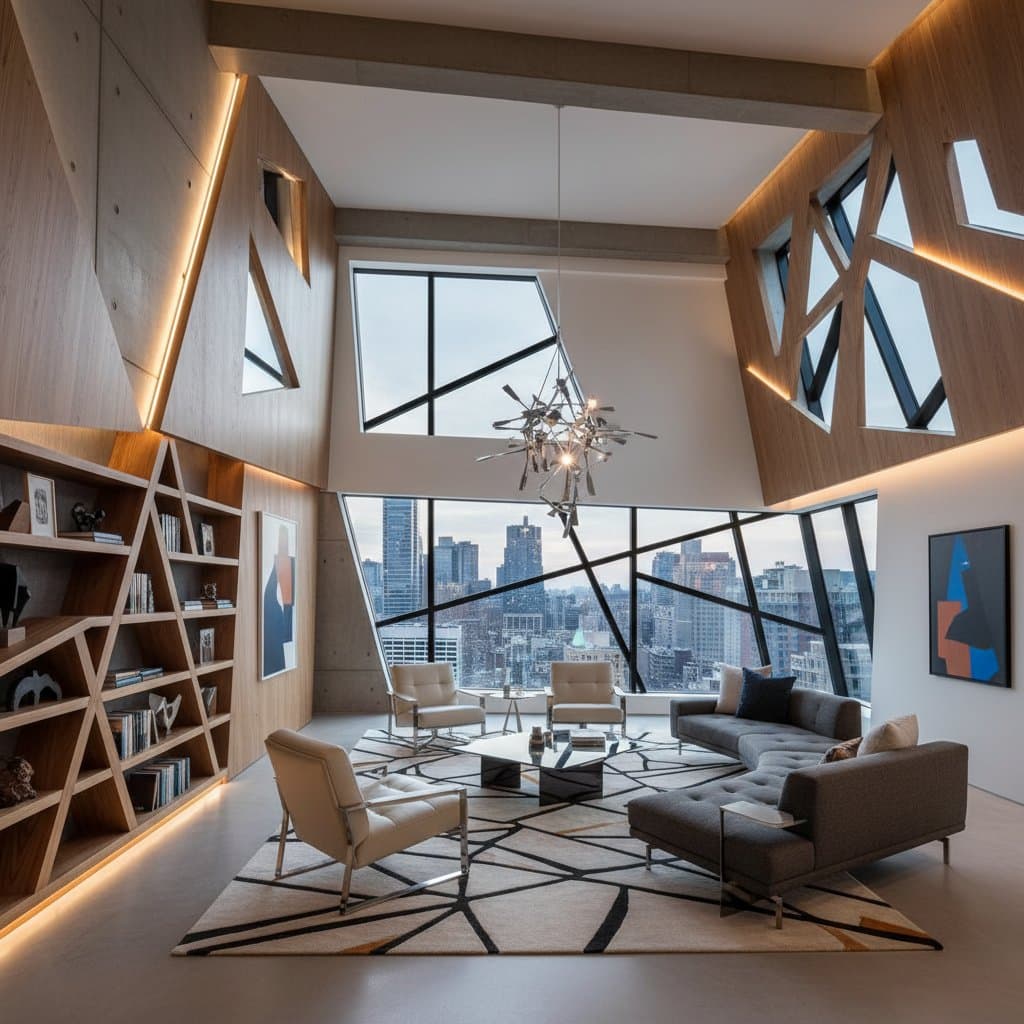
The Emergence of Fragmented Spaces in Deconstructivist Design
A visitor enters a room anticipating orderly arrangements, straight lines, and balanced compositions. Instead, the space reveals walls that tilt at unexpected angles, light that scatters across uneven surfaces, and furnishings positioned with deliberate irregularity. This initial disorientation soon gives way to a sense of vitality. Fragmented spaces form the foundation of deconstructivist design, infusing interiors with movement and character.
Homeowners increasingly adopt this style to escape conventional layouts. These spaces promote dynamism, personal expression, and adaptability. Practical concerns arise, however, such as ensuring comfort in asymmetrical environments, managing renovation costs, and upholding functionality amid creative disruptions. This article examines the role of fragmented spaces in deconstructivist architecture and interiors, their growing popularity, and strategies for integrating them into residential settings with care and precision.
Reasons Homeowners Adopt Deconstructivist Interiors
Conventional design emphasizes equilibrium and predictability, where elements align in harmonious patterns. Fragmented spaces diverge from this norm, attracting individuals who seek interiors that reflect personal narratives and unbound creativity.
Several factors contribute to the rising interest in this approach:
-
Personal Narrative Through Design
Irregular geometries and abrupt transitions craft environments that convey individuality. Homeowners disillusioned with standardized floor plans find liberation in designs that mirror their unique perspectives. -
Dynamic Visual Stimulation
Slanted partitions, varying depths, and multifaceted textures guide the gaze continuously, simulating motion in static settings. This perpetual engagement energizes the atmosphere without requiring physical activity. -
Innovative Spatial Solutions
Fragmentation addresses challenging layouts, such as irregular room shapes or limited square footage. Rather than imposing uniformity, the design leverages existing quirks to enhance usability and flow. -
Tension via Material Diversity
Pairing industrial elements like exposed concrete with translucent glass, or sleek metal alongside organic wood, generates intriguing contrasts. These combinations add depth and sensory appeal, elevating the tactile experience.
Integrating Fragmented Design into Residential Spaces
Deconstructivist principles require no grand architectural overhaul to make an impact. Homeowners can incorporate fragmentation gradually, from minor layout adjustments to more ambitious modifications.
Introduce Angles and Geometric Variations
Standard residential construction favors perpendicular lines, which can feel restrictive. Introduce diagonal features through custom cabinetry that slices across a wall, or rearrange seating to form oblique pathways. Such alterations disrupt monotony and instill a subtle sense of progression, even in modest applications.
Harness Light and Shadow Dynamics
Illumination plays a pivotal role in accentuating fragmentation. Install adjustable spotlights or linear LED arrays to cast elongated shadows that emphasize contoured surfaces. These effects transform ordinary light into a sculptural component, deepening the room's perceptual layers.
Combine Materials for Textural Depth
Juxtapose disparate finishes to amplify visual and physical interest. For instance, pair a glossy epoxy resin countertop with matte brick accents and soft fabric upholstery in one area. Employ a minimum of three contrasting materials to build complexity, ensuring each selection complements the overall palette.
Alter Levels and Spatial Planes
Budget permitting, incorporate vertical shifts like a stepped platform for a lounge area or a lowered floor section for intimate gatherings. Ceiling treatments, such as asymmetrical bulkheads or varying heights, further fragment the overhead plane. These changes create zones without necessitating full renovations.
Reconfigure Furniture Arrangements
Abandon axial symmetry in favor of asymmetrical groupings. Position a sectional sofa to intersect a pathway at an angle, or align a console table parallel to a diagonal wall. Proportions serve as the guiding force here, maintaining equilibrium through scale rather than mirror-image placement.
Achieving Equilibrium in Emotion and Utility
Inhabiting fragmented environments delivers an invigorating experience, though adaptation takes time. Perceptions shift from initial unease to appreciative stimulation as familiarity grows. Success hinges on equilibrating aesthetic innovation with ergonomic needs.
Consider these principles during planning:
- Design circulation routes that remain unobstructed and instinctive.
- Select uniform surfacing to provide subtle cohesion amid diversity.
- Incorporate steadfast focal points, such as a prominent hearth or expansive glazing, to ground the composition.
- Embed concealed storage solutions to curb accumulation, preserving the clarity of irregular forms.
Fragmentation thrives when it sparks exploration without inducing bewilderment.
Adapting Fragmented Design to Local Contexts
Deconstructivist fragmentation varies by geographic and environmental factors. In moisture-prone regions, protect raw metals or porous concretes with durable sealants to resist degradation. Colder climates demand meticulous insulation at angled junctions to minimize heat loss.
Regulatory standards often limit radical forms, particularly near lot lines or structural limits. Collaborate with architects and builders versed in regional nuances to guarantee compliance while sustaining artistic intent.
Implementing Fragmented Spaces Effectively
Begin experimentation with non-permanent changes, such as asymmetrical decor arrangements or partitioned zones using modular screens. Monitor how these modifications influence daily navigation and mood to inform further steps.
For comprehensive overhauls, engage specialists proficient in deconstructivist techniques who prioritize practicality alongside innovation. Scrutinize preliminary renderings and prototypes to align the outcome with visions of vitality and habitability.
Fragmentation reimagines residential spaces as evolving narratives. Thoughtful application unlocks authentic, irreplaceable homes that resonate on personal levels.