
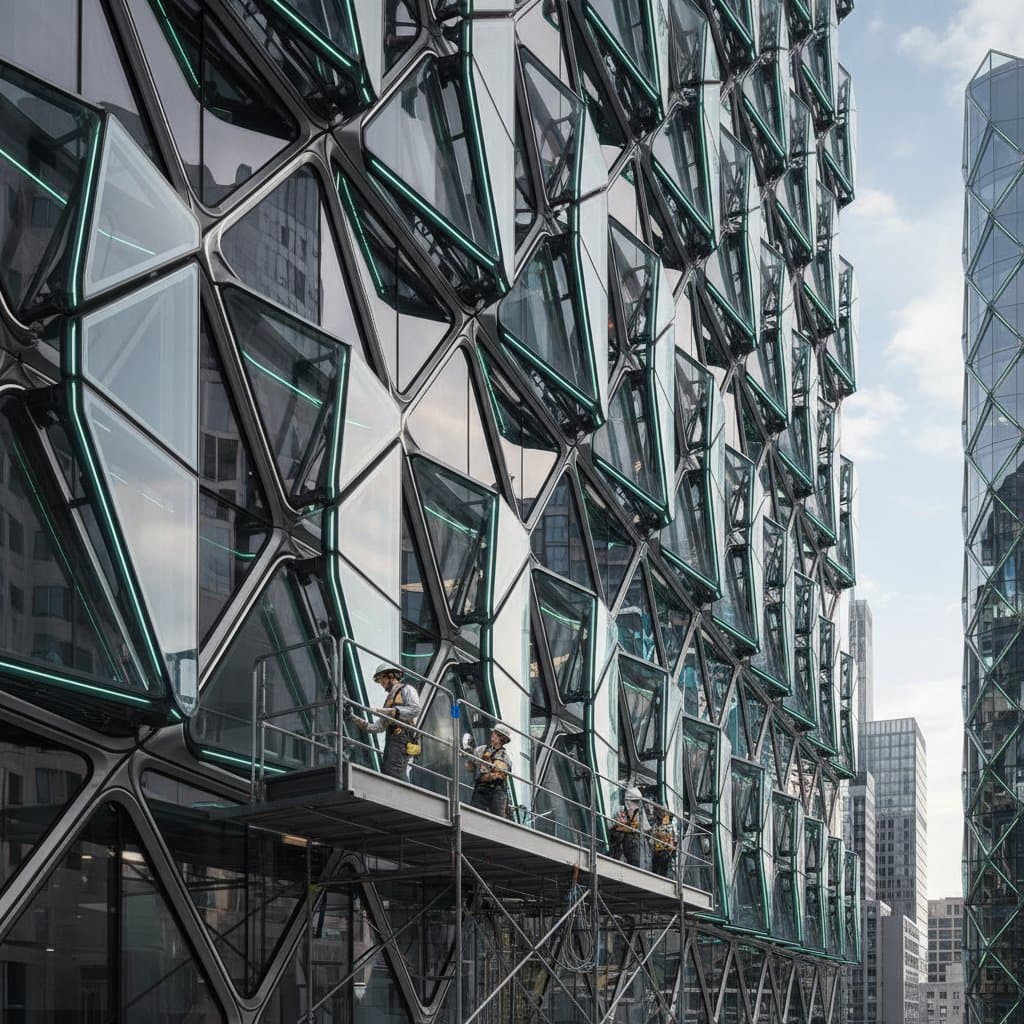
Algorithmic Facades Shaping 2026 Architecture Trends
Modern buildings increasingly exhibit lifelike qualities. Walls shift subtly, alter hues with the passage of time, or adjust to atmospheric conditions. Architects move beyond rigid structures to develop facades that interact with sunlight, shadows, and breezes through algorithmic controls. This evolution delivers energy savings, adaptable forms, and striking aesthetics, while prompting considerations of expenses, upkeep, and technological integration.
The Opportunity in Smarter Building Skins
Urban expansion and escalating energy prices demand buildings that exceed aesthetic appeal. They must evolve dynamically. Algorithmic facades enable this adaptation via computer-guided mechanisms that regulate shading elements, ventilation apertures, or surface textures. Sensors and programmed directives automate responses to thermal variations, illumination, and air currents, yielding structures that vary in appearance daily yet prioritize occupant comfort and reduced consumption.
For new developments or retrofits, integrating these facades warrants exploration. Such incorporation demands a conceptual pivot, yet it yields enduring financial benefits and superior operational efficiency.
How Algorithmic Design Works in Architecture
Algorithmic design employs mathematical models or computational directives to formulate geometries and functionalities. In architectural contexts, scripts dictate panel deployments or fin orientations according to solar intensity. Designers input objectives like minimizing thermal ingress or optimizing natural light, prompting the system to evaluate myriad configurations for optimal outcomes.
This methodology aligns with parametric design, wherein components interconnect through modifiable variables. Examples include:
- Panel dimensions scaled to solar exposure levels.
- Aperture adjustments aligned with prevailing winds.
- Material properties that modulate opacity under thermal stress.
Such processes render design iterative and tailored, supplanting intuition with empirical guidance.
Why Dynamic Facades Are Gaining Popularity
Architects embrace algorithmic facades for three primary advantages:
-
Energy efficiency
Precise solar management diminishes reliance on mechanical climate control, potentially slashing consumption by 20 to 40 percent relative to static alternatives. -
Visual appeal
Kinetic or chromatic shifts create rhythmic patterns that elevate structures to iconic status within urban landscapes. -
Comfort and usability
Regulated illumination, enhanced ventilation, and glare mitigation foster environments that support focus and health.
Implementation demands meticulous coordination, dependable hardware, and structured upkeep protocols.
Step-by-Step: How Architects Develop Algorithmic Facades
Facade development merges creative intent with computational precision. The following outlines the typical sequence.
-
Define the purpose
Articulate core functions, such as thermal regulation, luminous optimization, or kinetic expression. Precise objectives refine algorithmic development. -
Collect environmental data
Compile site-specific metrics including solar trajectories, wind vectors, diurnal temperature fluctuations, and building alignment. These inputs anchor the computational framework. -
Set the parameters
Establish variables like element dimensions, pivot ranges, opacity gradients, or spectral alterations. These allow iterative fine-tuning for peak efficacy. -
Run simulations
Employ modeling tools to assess performance across climatic scenarios, quantifying light penetration, energy offsets, and diurnal aesthetics. -
Refine and fabricate
Optimize emergent configurations for manufacturability, leveraging techniques such as CNC milling or additive layering to realize intricate geometries. -
Monitor and maintain
Post-deployment, integrated sensors relay real-time inputs to the controller. Algorithms adapt autonomously or via periodic recalibration to accommodate temporal shifts.
Examples of What You Might See
Algorithmic facades manifest diversely, attuned to visionary directives and contextual demands. Configurations range from articulated panels tracking solar arcs to etched barriers diffusing radiance like filigree. Innovations extend to electrochromic glazing that modulates tint on demand.
Common variants include:
- Responsive shading panels: Mechanisms that articulate to modulate solar influx.
- Perforated metal screens: Algorithmically patterned fixed elements that balance aeration and luminosity.
- Dynamic louvers: Motorized vanes that pivot per sensor directives.
- Smart glazing: Surfaces that alter transmittance through voltage application.
Selections balance fiscal outlay, mechanical intricacy, and expressive potential.
Pros and Cons to Keep in Mind
Prospective adopters should evaluate merits against hurdles.
Pros:
- Substantial reductions in operational energy expenditures
- Unique silhouettes that enhance site prominence
- Elevated interior environments promoting occupant satisfaction
- Versatility for reconfiguration or multifunctional use
Cons:
- Elevated upfront investments in conceptualization and production
- Intensified servicing needs for actuated components
- Vulnerability to software or sensor malfunctions
- Requirement for interdisciplinary installation proficiency
For most stakeholders, long-term gains eclipse initial barriers, provided budgets account for realities.
Costs, Timelines, and Practical Factors
Automated facades incur premiums over inert enclosures, augmenting cladding allocations by 10 to 30 percent contingent on sophistication. Control architectures significantly influence expenditures; basic actuators prove economical, whereas expansive arrays of independent actuators escalate costs.
Design timelines elongate during parametric exploration and validation phases. Conversely, computational accuracy accelerates assembly, with components prefabricated to exact tolerances.
Upkeep planning proves essential. Actuation demands routine inspections, while detectors necessitate alignment. Remote diagnostics suit many setups, supplemented by on-site interventions. Allocating 1 to 2 percent of facade value annually sustains reliability.
Regulatory compliance merits attention. Jurisdictions may mandate structural validations for dynamic assemblies or certifications for intelligent materials. Engaging seasoned professionals streamlines adherence.
How Algorithmic Design Changes the Architect’s Role
Traditional architecture emphasized immutable silhouettes. Algorithmic paradigms broaden responsibilities to encompass behavioral orchestration and analytic synthesis. Practitioners evolve into integrators, crafting not merely appearances but responsive ecosystems.
This transformation fosters interdisciplinary synergy among designers, technicians, and programmers. Collective algorithm authorship harmonizes aesthetics with ecological imperatives, democratizing outcomes through verifiable metrics over subjective judgment.
The Broader Appeal of Parametric Thinking
Facade applications often extend parametrically across structures. Unified variables govern skeletal frameworks to spatial arrangements, yielding integrated wholes.
For instance, facade directives can synchronize with internal systems, automating luminance or air exchange in tandem with external cues. Such synergy amplifies efficiencies, epitomizing advanced sustainable paradigms.
Environmental and Social Benefits
Beyond fiscal prudence, these facades reshape civic interactions. They provide ambulatory shelter, temper ambient heat, and soften reflective glare. Thoughtful deployment cultivates equitable urban vitality.
Sustainably, algorithmic iteration minimizes material excess by virtual prototyping, curtailing on-site revisions and resource depletion.
When to Choose Algorithmic or Dynamic Facades
Suitability aligns with environmental complexity or expressive priorities. Ideal candidates encompass:
- Commercial edifices with expansive fenestration under intense insolation
- Institutional venues seeking emblematic presence
- Multifamily developments prioritizing wellness and conservation
- Adaptive retrofits enhancing legacy performance sans overhaul
Budget-constrained endeavors benefit from subdued applications, such as algorithm-derived static motifs delivering comparable shading sans motility.
Pro Tips for Success
- Integrate from inception. Embed computational logic within foundational concepts.
- Engage experts. Partner with structural and digital specialists for robust execution.
- Validate through models. Prototype subsets to assess material dynamics pre-scaling.
- Secure upkeep protocols. Designate oversight for diagnostics and adjustments.
- Prioritize end-users. Ensure adaptations enhance daily experiences.
Integrating Responsive Systems for Lasting Impact
Algorithmic facades fuse artistry, utility, and innovation into adaptive envelopes. Though demanding foresight and capital, they deliver enduring economies and memorable forms.
Consult parametric-savvy professionals to align site analytics with viable substrates. Weigh advanced and elemental strategies per fiscal parameters. As adoption proliferates, these technologies will animate metropolises, rendering edifices as vital, attuned entities that elevate efficiency and engagement.